
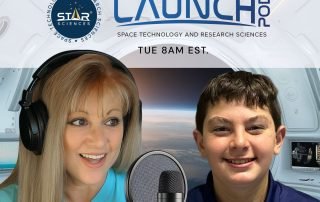
Meet Lucas Lowery: The 12-Year-Old Shaping Future Space Missions
Discover how a passionate seventh grader is already presenting at national space conferences, building CubeSats, researching AI, and shaping the future of space exploration. Meet Lucas Lowery—the young innovator proving the next generation is ready for liftoff. Shorter- At just 12, Lucas Lowery is building satellites, speaking at space conferences, and preparing for Mars. This rising star is the future of aerospace. Susan Wise: Hi, and welcome to Stars Launch Pod, Space Technology and Research Sciences, brought to you by StarSciences.org, where we connect, collaborate, and accelerate. I'm your host, Susan Wise, and I'm honored to have with
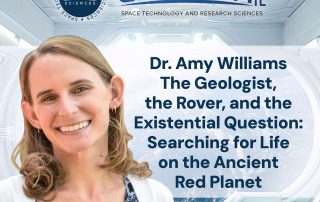
The Geologist, the Rover, and the Existential Question: Searching for Life on the Ancient Red Planet
The Detective Work in the Ancient Rock Record Dr. Williams is a professor in the geology department at the University of Florida. She holds a PhD, clarifying that she is a "doctor of course... and not the MD doctor" because, thankfully, she prefers rocks to blood. Her research centers on applying her knowledge of rocks and life to study how life is preserved in the ancient rock record on Earth. This is the foundation for her work in geobiology and astrobiology. Her primary focus with NASA is working directly with the data coming back from the Mars Rovers Curiosity
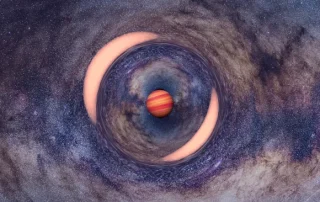
Astronomers detect rare ‘free floating’ exoplanet 10,000 light-years from Earth
Rogue planets — worlds that drift through space alone without a star — largely remain a mystery to scientists. Now, astronomers have for the first time confirmed the existence of one of these starless worlds by pinpointing its distance and mass — a rogue planet roughly the size of Saturn nearly 10,000 light-years from Earth. Planets are typically found bound to one or more stars. However, in 2000, astronomers detected the first signs of a "rogue planet" — a free-floating world that orbited no star. Then, in 2024, researchers detected an object distorting the light from a distant star, simultaneously from both

Turning Space Debris Into Opportunity with Ubaldo “The Space Ace” Ciminieri
Join host Susan Wise as she sits down with Ubaldo “The Space Ace” Ciminieri, Chief of Staff at CisLunar Industries, to explore how the future of space power, recycling, and innovation is turning science fiction into reality. From transforming space debris into usable materials to empowering new voices in the space industry, this episode is a reminder that space needs everyone’s talent and imagination. Susan Wise: Welcome to Stars Launch Pod: Space Technology and Research Sciences, brought to you by StarSciences.org — where we connect, collaborate, and accelerate. I’m your host, Susan Wise, and today we’re very excited
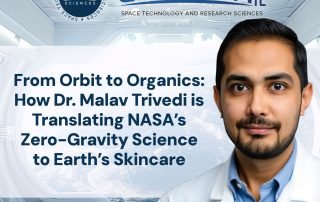
From Orbit to Organics: How Dr. Malav Trivedi Is Translating NASA’s Zero-Gravity Science to Earth’s Skincare
Dr. Malav Trivedi, the founder of Zero Gravity Sciences, operates at the intersection of high-stakes space technology and human health. A pharmacist by training with a Master’s and Ph.D. in neuroscience, his academic foundation lies in epigenetics—the study of how daily environmental factors, such as diet, sleep, nutrition, and pollution, affect gene expression and bodily metabolism. His journey to becoming a pioneer in applied space biology began by studying how microgravity might affect stem cell development and formation. This research led him to a remarkable technology developed by NASA back in the 1960s and 1970s: microgravity bioreactors. This system,

First-ever ‘superkilonova’ double star explosion puzzles astronomers
Scientists may have witnessed a massive, dying star split in two and then crash back together, triggering a never-before-seen double explosion. The explosion sent ripples through space-time and forged some of the universe's heaviest elements. Most massive stars reach the ends of their lives by collapsing and exploding as supernovas, seeding the cosmos with elements such as carbon and iron. A different kind of cataclysm, known as a kilonova, occurs when the ultradense remnants of dead stars, called neutron stars, collide, forging even heavier elements like gold. The newly identified event, named AT2025ulz, appears to combine these two types of