

Space Migration & the Next Frontier: Insights from Tyler Bender, Beyond Earth Institute
Join host Susan Wise on the Stars Launch Pod as she talks with Tyler Bender, Policy Analyst at the Beyond Earth Institute, about the future of human space settlement, space policy, and how everyday careers on Earth can shape life beyond our planet. Discover insights on space migration, innovation, and building sustainable communities beyond Earth. Susan Wise: Hi, and welcome to Stars Launch Pod, Space Technology and Research Sciences, brought to you by StarSciences.org, where we connect, collaborate, and accelerate. I’m your host, Susan Wise, and joining us today is Tyler Bender, Policy Analyst for the Beyond Earth

Scientists spot ‘unprecedented celestial event’ around the ‘Eye of Sauron’ star just 25 light-years from Earth
Astronomers hoping to observe a planet around a nearby star have witnessed a much rarer "unprecedented celestial event," the team said: The violent aftermath of not one, but two collisions between the rocky building blocks of planets. Over the past two decades, astronomers witnessed two separate catastrophic collisions around the star Fomalhaut, located just 25 light-years away in the constellation Piscis Austrinus. The detections occurred after planetesimals (rocky pieces of unformed planets) measuring much larger than the dinosaur-killing asteroid smashed each other into massive clouds of glittering debris. Read Article

The Retrieval Artist: Anna Lee Fisher on Rescuing Satellites, Making History, and Tackling Space Debris
Anna Lee Fisher carries a unique legacy in the history of human spaceflight. Not only was she selected in the inaugural class of female astronauts for the Space Shuttle program, but in 1984, during Mission STS-51A, she became the first mother to fly in space. In a recent interview with Susan Wise on the STARSLaunchPod, Dr. Fisher, a retired NASA astronaut and celebrated icon, reflected on her pioneering journey, the high-stakes mission that defined her career, and her current efforts to ensure the sustainability of the orbital environment. The STS-51A: A Rescue Mission Against the Clock Dr. Fisher’s flight

Jess Bunchek on Space Farming, Aeroponics & DLR Research
Can we grow fresh food in space? Astrobotanist Jess Bunchek takes us inside her work at DLR, from Antarctica to advanced aeroponics, revealing how space farming could transform life both off-world and here on Earth. Susan Wise: Welcome to Stars Launch Pod: Space Technology and Research Sciences, brought to you by StarSciences.org, where we connect, collaborate, and accelerate. I'm your host, Susan Wise, and I’m thrilled to have with us today Jess Bunchek, astrobotanist and PhD candidate at DLR. Basically, you’re a plant scientist, right? Jess Bunchek: A very specialized plant scientist. Susan Wise: I love it. Welcome
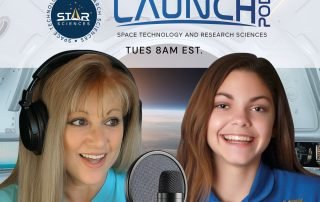
Alyssa Carson on Mars, Astrobiology & Inspiring the Next Generation of Space Explorers
Join us as we talk with Alyssa Carson, astrobiologist and aspiring astronaut, about her journey from a curious child fascinated by space to a pioneering researcher exploring the possibility of life on Mars. Discover the challenges, triumphs, and inspiring advice from someone chasing her dreams beyond Earth—and learn how she’s empowering the next generation to do the same. Susan Wise: Hi, and welcome to Stars Launch Pod: Space Technology and Research Sciences, brought to you by StarSciences.org, where we connect, collaborate, and accelerate. I'm your host, Susan Wise, and joining us today is Alyssa Carson, astrobiologist and aspiring

James Webb Space Telescope discovers a hot Jupiter exoplanet leaking twin gas tails that defy explanation
Astronomers have used the James Webb Space Telescope (JWST) to discover that a distant "hot Jupiter" planet has two staggeringly long tails composed of helium that currently defy explanation. The observations represent the first study of gases leaking from a planet beyond the solar system during one of its complete orbits, and help paint the most complete picture of atmospheric escape thus far. The extrasolar planet, or exoplanet, in question is WASP-121b, also known as "Tylos," located around 858 light-years away. WASP-121b is an example of an "ultrahot Jupiter," a massive gas giant planet found so close to its parent star that it