
Revolutionizing Space Water Systems: Dr. Paul Westerhoff on UV Light, Biofilms & the ISS
Join host Susan Wise as she talks with Dr. Paul Westerhoff, Regents Professor at Arizona State University, about his groundbreaking work using UV light to control biofilms on the International Space Station. Discover how this innovative, chemical-free technology could revolutionize water systems both in space and here on Earth—from keeping astronauts safe to transforming how we manage clean water and prevent contamination. Susan Wise: Welcome to Stars Launch Pod: Space, Technology, and Research Sciences, brought to you by Starsciences.org, where we connect, collaborate, and accelerate. I'm your host, Susan Wise, and joining us on the podcast today is
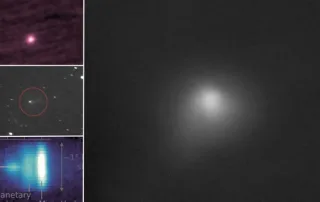
4 key things NASA just revealed about the interstellar comet 3I/ATLAS
Since the interstellar comet 3I/ATLAS was discovered this past July — just the third confirmed object to arrive from another star — astronomers have been closely following its passage through our solar system. As the icy visitor brightened on its coast toward the sun, the public narrative brightened too, with online rumors casting it as a possible alien spacecraft during the recent 43-day-long government shutdown when NASA could not comment on the object or release new images. Last week, with the shutdown over, NASA held a long-awaited briefing in which it shared observations and early analysis from more than
Beyond the Pickaxe: How Swarm Robotics and “Touchless Mining” Are Paving Humanity’s Way to Mars
The ambition to expand humanity beyond Earth's ecosystem and into the solar system requires a foundational economic engine. For Jim Keravala, the CEO and Chief Architect of Offworld, that engine is mining. Caravala notes that the first stage of industrialization, whether on Earth or extraterrestrially, is typically mining, followed by construction, manufacturing, and fabrication. Offworld's vision is built on this sequence, pioneering a revolutionary swarm robotic mining architecture. "The premise around Offworld is really born from our vision and passion about seeing humanity expand beyond Earth's ecosystem into the solar system," Caravala explains. The Robot Puppies and 24/7 Mining
Inside the ISS: Breakthrough Science with Ryan Reeves
Discover how cutting-edge space research—from cancer treatments and artificial retinas to fiber-optic breakthroughs—is transforming life here on Earth. Ryan Reeves, Technical Director of Research & Innovation at the International Space Station National Laboratory shares behind-the-scenes stories, surprising discoveries, and a look at what’s next after the ISS. Susan Wise: Hi, and welcome to Stars Launch Pod: Space, Technology, and Research Sciences, brought to you by StarSciences.org, where we connect, collaborate, and accelerate. I’m your host, Susan Wise, and I’m excited to welcome today’s guest, Ryan Reeves, Technical Director of Research and Innovation at the International Space Station National

Blue Origin announces New Glenn upgrade plans
MUNICH — A week after successfully launching and landing the current version of New Glenn, Blue Origin announced a series of upgrades to the vehicle. The company said Nov. 20 it plans to increase the thrust of the engines used on New Glenn and make other improvements. The upgrades include increasing the thrust of the seven BE-4 engines on the rocket’s first stage from a combined 3.9 million pounds-force to 4.5 million pounds-force. The two BE-3U engines on the upper stage will increase their total thrust from 320,000 to 400,000 pounds-force. “These enhancements will immediately benefit customers already manifested

Solving the Unsolvable: A Payload Lead on Real-Time Crisis, Confidence, and Thriving in NASA’s Chaos
For Stephanie Anderson, the work happens in the urgent, high-stakes environment of Mission Control. As the Payload Operations Lead, Anderson has spent over 10 years on the International Space Station (ISS) program, commanding the team responsible for ensuring the successful execution of science experiments and research facilities orbiting 250 miles above Earth. Her job is centered on supporting NASA-sponsored payload facilities on board the space station, meaning she and her team must guarantee these facilities function properly. When malfunctions or unexpected issues arise, they are the rapid-response team, helping diagnose the problem and get it fixed quickly so that